Confidence, Motivation, and Inspiration
Self-care that ignores the people who grew your botanicals is not whole-person wellness.
That is a hard thing to read if you have spent real money building a wellness practice. The botanicals in your morning ritual, the herbs in your evening wind-down, the plants you reach for when your body is asking for something real- every single one came from somewhere. From soil, from hands, from a supply chain that either honors or exploits the people at the beginning of it.
This is not a guilt trip. That is not how we do things here.
This is an invitation to look at the full picture of what sustainable herbal tea sourcing actually means, and why, at LMH Custom Teas & Herbs, it has never been a trend or a marketing talking point. It has always been the foundation. Because making the world a better place, one positive impact at a time, does not start with grand gestures. It starts with what you put in your cup.
Sustainable herbal tea sourcing means selecting organic, ethically grown, and responsibly harvested ingredients from growers and suppliers who prioritize human welfare, ecological health, and equitable compensation. It matters because the herbs in your cup carry the energy of the conditions in which they were grown. When sourcing is carefully managed, it can support ingredient quality while reducing exposure to certain contaminants that may prevent your body from absorbing what a cleaner, more bioavailable, nutrient-dense product may provide.
When sourcing is ethical, the people who tended those plants receive fair compensation, safe working conditions, and dignified livelihoods. And when communities at the source thrive, that abundance extends outward. What you choose to pour into your cup is a vote for the kind of world you want to be part of.
Bottom Line: Sustainable herbal tea sourcing goes beyond choosing organic ingredients—it reflects a commitment to ethical farming, environmental stewardship, and product quality. By purchasing responsibly sourced herbal teas, consumers can support their own wellness while contributing to healthier ecosystems and more resilient farming communities.
Wellness culture has a selective vision problem.
We have become extraordinary at zooming in on the individual. The personal ritual. The intentional herbal blend. But we rarely zoom out to ask where any of it came from. Who grew it? What that person was paid. What was applied to that field? What happened to the soil afterward?
Healing from the root means more than supporting your own wellbeing. It means caring where your roots come from.
When you purchase herbs from a large commercial supplier who uses conventional farming practices, your purchase funds a system that may rely on synthetic pesticides, deplete the soil over seasons of monoculture farming, and pay agricultural workers poverty wages for labor-intensive harvests. None of that energy disappears when the herb gets dried and packaged. Ancient traditions have always understood that the conditions in which a plant grows directly shape its potency and character.
This is not abstract. This is the reason sustainable herbal tea sourcing is a values issue, a wellness issue, and a community impact issue all at once. It is also the reason LMH Custom Teas & Herbs is built the way it is.
“Sustainable” is everywhere right now. That is exactly why we need to be precise about it.
Sustainable sourcing, in the context of herbal tea and botanical wellness, refers to an ongoing commitment to acquiring ingredients through methods that support the long-term health of the plants, the soil, the ecosystems, and the human communities involved in cultivation and harvest. According to the Food and Agriculture Organization of the United Nations, sustainable food systems must be profitable, environmentally sound, and socially equitable simultaneously. One without the others is not sustainable. It is a partial story.
Greenwashing, on the other hand, is the practice of using “natural,” “sustainable,” or “eco-friendly” language in marketing without substantive practices behind it. A wellness brand can use recyclable packaging and still source herbs from exploitative supply chains. The packaging does not tell the whole story.
Genuine sustainable sourcing may look like: organic certification from a recognized body, fair-trade or direct-trade relationships with small growers, transparent ingredient origins, small-batch harvesting that allows soil and plant populations to regenerate, and supply chains short enough that the brand actually knows where, and from whom, they are buying.
At LMH Custom Teas & Herbs, this is not aspirational language. Our ingredient selections, from organic moringa to organic chamomile to organic oat straw, reflect a deliberate standard we hold ourselves to because the people you support when you buy from us deserve to be supported in return.
Take a slow breath before reading this section.
Notice where your body is right now. The weight of your hands. The pace of your breath. You are here because you are trying to support your wellbeing. That matters. And this next part is not meant to alarm you. It is meant to give you information so you can make aligned choices.
Conventionally grown herbs are often among the most heavily treated crops in commercial agriculture. Research published by the National Institutes of Health has documented the presence of organophosphates and other synthetic pesticide residues in many commercially grown tea products. When herbs are steeped in hot water, the heat may draw those residues directly into your tea infusion.
For someone building an intentional wellness practice, that is a significant concern. The whole point of reaching for an herb is to support your body. Introducing synthetic chemical residue alongside that herb works against the foundation you are building.
Organic certification, at its core, means the USDA National Organic Program has verified that no synthetic pesticides, herbicides, or fertilizers were used in production. Some studies also suggest that organically grown plants may differ in their concentrations of certain beneficial phytochemicals. Although findings vary by plant, growing conditions, and study design, those defenses are part of what makes the herb valuable in the first place.
Nothing here is a guaranteed outcome. Everybody is different. But for a wellness brand that exists to support your body rather than introduce new variables of concern, organic sourcing is simply the honest standard.
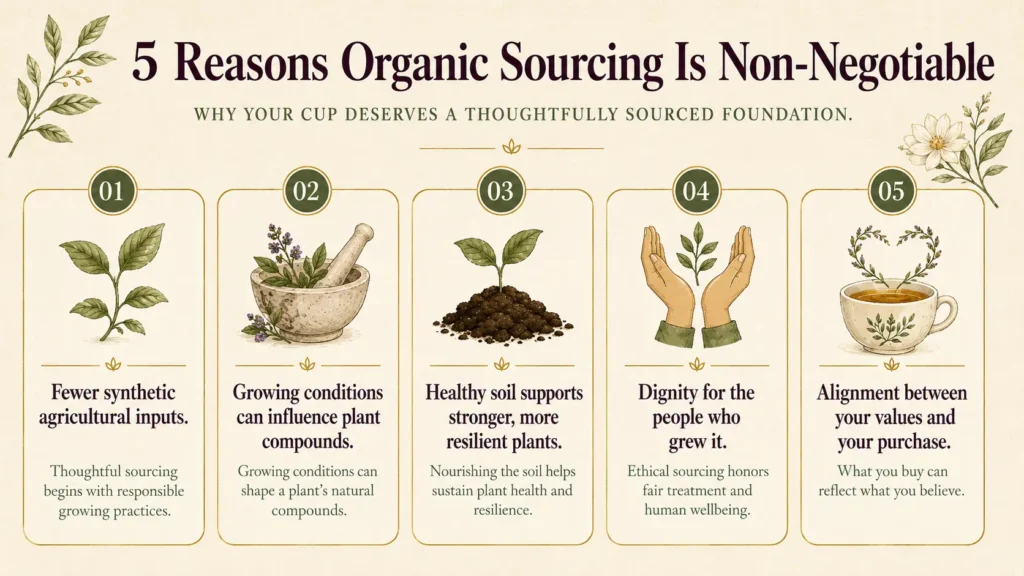
Organic farming may also support the long-term health of the soil in ways that conventional farming does not. Research from the Rodale Institute and published agricultural science suggests that organically managed soil can support higher microbial diversity and greater carbon sequestration capacity over time. Healthier soil can contribute to more nutrient-dense and resilient plants, contributing to more sustainable growing conditions and potential health benefits.
This is inner landscape thinking applied outward: if the soil is depleted, the harvest reflects that. If the soil is nourished, the plant thrives. If the plant thrives, so may the person who receives it. These things move in one continuous system.
This is the part of the sustainable sourcing conversation that does not get said enough.
Global herbal tea and spice production is disproportionately concentrated in regions where agricultural labor wages are low, worker protections may be limited, and harvesting is physically demanding seasonal work. According to data from the International Labour Organization, agricultural workers remain among the world’s most economically vulnerable labor populations.
When a wellness brand cuts costs by sourcing from the cheapest available supplier, that savings does not appear out of nowhere. It comes directly from the margins paid to the people doing the work. Your $6 bag of conventional herbal tea may reflect a supply chain where the person who harvested it received the smallest fraction of that value.
Certified Fair-trade aligned sourcing does not eliminate all inequity in global agriculture. But it can create structured accountability through mechanisms such as minimum pricing requirements, community development funds, transparent audits, and direct grower relationships that prioritize human dignity alongside product quality. When you choose LMH Custom Teas & Herbs, you are supporting a brand that considers the people and communities behind its ingredients, not just by supply contract or the finished product.
Abundance is not a personal achievement. It is a collective condition.
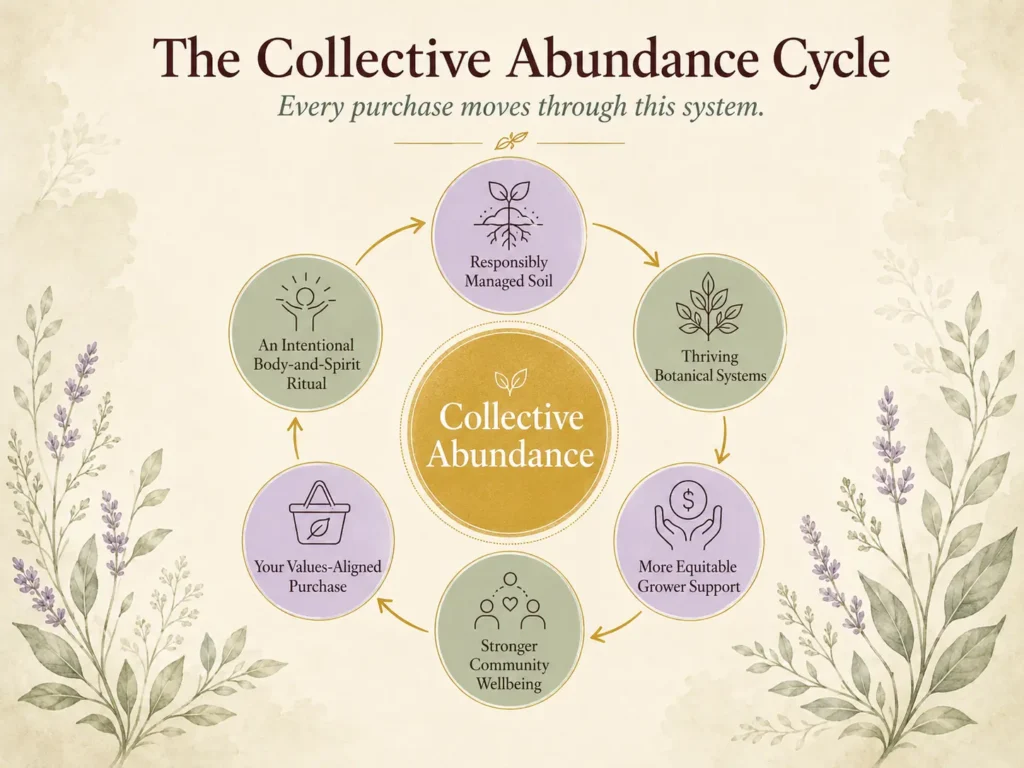
The shift from a survival mindset to an abundance mindset, which Briana addresses directly through Divine Empowerment Holistic Coaching, is not just an internal psychological shift. It is also a practice we enact in how we spend, source, and support. Collective abundance means structuring your choices so that the people at the beginning of the chain are also thriving.
This is what “making the world a better place, one positive impact at a time” looks like when it is lived rather than stated. Your purchasing decisions are not separate from your wellness practice. They are part of it.
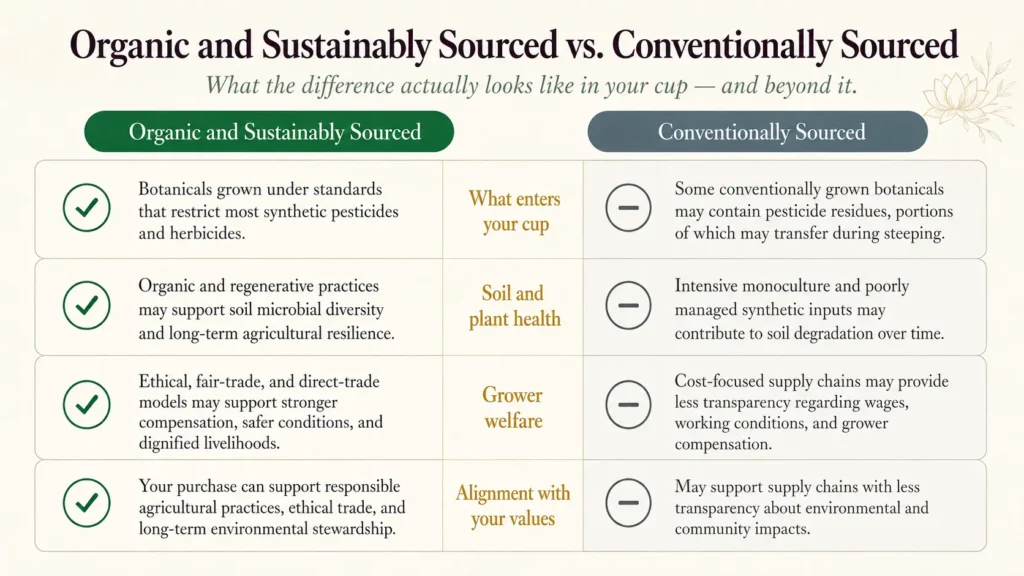
| Category | Organic and Sustainably Sourced | Conventionally Sourced |
| What is in your cup | Grown according to organic standards that restrict most synthetic pesticides, fertilizers, or herbicides. You receive the plant as intended, with nothing added that your body did not ask for and it reduces reliance on many conventional agricultural inputs. | May contain synthetic pesticide residue that can be extracted into hot water during steeping, introducing variables that work against the purpose of the ritual. Residue levels vary by plant, source, and production method. |
| Soil and plant health | Organic and regenerative practices may support microbial diversity, soil health, and long-term agricultural resilience. Nourished soil can produce a more potent, nutrient-dense plant over time and be more self-regenerative. | Certain intensive monoculture and synthetic input practices associated with monoculture farming can deplete soil over successive harvests, gradually reducing the vitality of the plant material produced and soil degradation when not responsibly managed. |
| Grower welfare | Fair-trade, direct trade, and ethically managed sourcing models may support stronger labor protections and more equitable compensation. | Supply chains focused primarily on minimizing cost may provide less transparency regarding wages, working conditions, and grower compensation. Agricultural workers in conventional supply chains can be among the most economically vulnerable globally. |
| Community impact | Responsible sourcing can circulate more value through grower communities and support long-term environmental stewardship. Your cup becomes an act of collective abundance in practice. | Lower retail prices may reflect environmental or labor costs that are not visible in the final product price. Savings are typically passed to the consumer while the cost becomes externalized onto the grower community and surrounding ecosystem. |
| Alignment with your values | Your wellness practice and your purchasing choices are in alignment. What you pour into your body reflects what you stand for beyond it. | A disconnect can exist between the intention behind the ritual and the conditions that made the product available at that price point. |
Collective abundance is the understanding that true prosperity is not zero-sum. When the grower thrives, you receive a better product. When the soil is nourished, the plant is more potent. When the supply chain is equitable, the entire system becomes more stable and more trustworthy. Your act of choosing organic, sustainably sourced herbal tea is a small, material expression of this principle.
This is the same principle that runs through the embracing abundance mindset content at LMH: abundance is not something you accumulate at others’ expense. It is something you cultivate through aligned action, rooted choices, and a willingness to see how connected we all actually are.
Every cup you pour can be an expression of that.
Our ingredient list is not random. Each herb in our handcrafted herbal infusions is selected for potency, purity, and sourcing integrity.
Organic moringa is a nutrient-dense botanical and is used in many of our functional botanical blends. We source it organically because the soil matters to moringa’s nutritional profile and because the communities that grow moringa deserve sustainable agricultural practices, not extractive ones.
Organic chamomile is a cornerstone of rest and relaxation support across our blended families. Choosing organically grown chamomile aligns with our commitment to limiting reliance on most synthetic agricultural inputs.
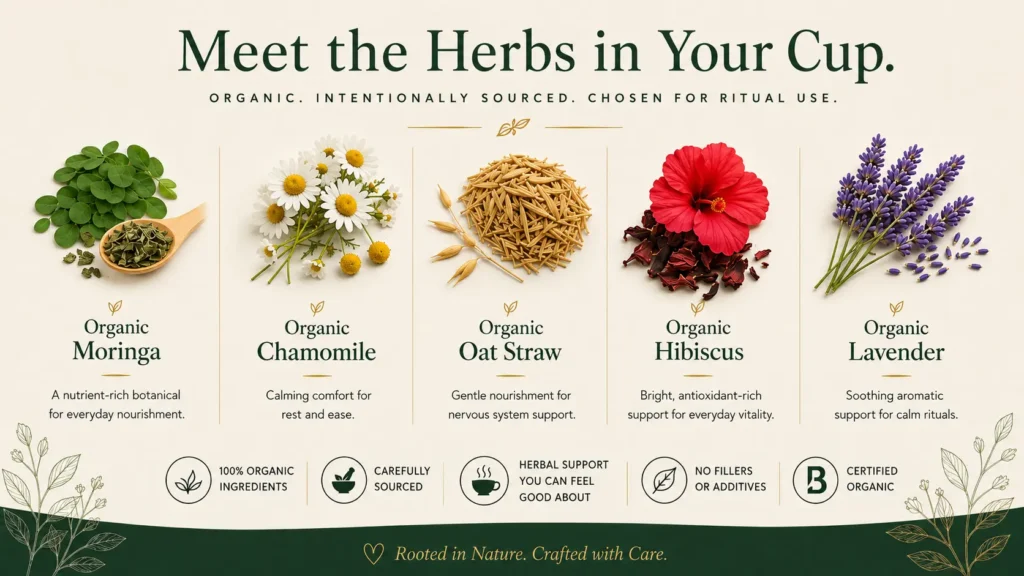
Organic oat straw brings grounding, mineral-rich nourishment to our rest and nervous system support blends. Oat straw grown according to organic standards produces a cleaner, more sensorially rich herb that aligns with our commitment to ingredient quality and a more intentional cup.
Organic hibiscus and organic lavender anchor our sensory and floral offerings, both serving as grounding, ritual-grade herbs in our chakra and relaxation blends.
Every one of these decisions reflects a standard we hold before the blend ever reaches your hands.
Small-batch loose-leaf tea blending allows us to stay close to our ingredients in a way that large-scale commercial production cannot. We know what is in each blend. We know where it came from. We can adjust sourcing when a supplier no longer meets our standard.
That is what integrity looks like at the product level.
USDA Certified Organic on a herbal tea label means the ingredients were grown without synthetic pesticides, synthetic fertilizers, genetic modification, or irradiation, and that the operation was audited and certified by an accredited certifying agent. It does not mean the product is medicinal-grade or that it guarantees any health outcome. It means the foundation of the product respects both the plant and the body receiving it.
Organic certification governs what is applied to the plant. Fair-trade certification governs how the people who grew it are compensated and protected. They are not the same thing, and a product can have one without the other. The most aligned sourcing combines both: clean growing practices and equitable compensation for the growers.
Often, yes. Organic certification, fair-trade premiums, and small-batch sourcing all carry costs that conventional supply chains avoid by externalizing them onto workers and ecosystems. A higher price on an organically sourced herbal tea reflects the real cost of doing it right. At LMH, we believe wellness should not be out of reach, and we work to make our products accessible while maintaining the standards that make them worth reaching for.
Some research suggests that organically grown herbs may have a different phytochemical profile than conventionally grown counterparts, though the science is still developing and results vary by herb and growing region. What is more consistent is that conventionally grown herbs may carry pesticide residue, and that sustainable soil practices produce a more stable, long-term growing environment. Whether or not you notice a difference in the cup, the difference in the supply chain is real.
You already know that wellness is not just what you consume. It is how you live, what you value, and where you put your support.
The herbs in our handcrafted tea blends are not sourced the way they are because it is easier. It would be considerably easier and cheaper to order from any large commercial distributor and build beautiful blends from conventional herbs. We do it this way because the standard we hold for your cup is the same standard we hold for the communities behind it. Because collective abundance is not a value we display. It is a practice we build into every choice we make.
Clarity. Balance. Growth. These are not destinations. They are the direction you move in when the whole system- the soil, the grower, the plant, and you- is being honored.
Your journey. Your pace. Your wellness. And now, your cup can carry that intention forward.
Browse the LMH Custom Teas & Herbs shop and find the blend that is rooted in everything we just talked about.
If you found this resonance, you are already living in alignment with the values behind every LMH blend. Stay connected through the LMH newsletter for seasonal sourcing updates, new blend releases, and whole-person wellness education delivered directly to your inbox. Share this post with someone in your circle who cares about where their wellness comes from. And if you are ready to explore how your daily tea ritual can be part of a larger whole-person support practice, book a complimentary tea consultation to explore which support option best fits your current season.
Disclaimer: I am a Certified Coach and Reiki Master; I am not a certified herbalist, licensed medical doctor, or pharmacist. The botanical suggestions, tea profiles, and lifestyle rituals offered on this website and during coaching sessions are for educational and informational purposes only. They have not been evaluated by the FDA and are not intended to diagnose, treat, cure, or prevent any medical condition. I only work with low-risk, culinary, and gentle botanical ingredients. While clients voluntarily disclose medications or underlying health conditions in an advanced assessment premium. We may use reputable educational references to meticulously cross-reference your lifestyle plans against any disclosed medications or underlying health conditions. This process is an educational safety check, not a medical review or substitute for individualized guidance from a physician or pharmacist. Always consult a qualified healthcare professional before introducing new plants, foods, or supplements into your routine, especially when taking prescription drugs, breastfeeding, pregnant, or managing a medical condition. This includes over-the-counter medication